
American Aquaculture Expansion Creates New Job Opportunities for the Next Generation
As bipartisan momentum builds around expanding domestic aquaculture and the industry emerges as a growing source of job creation for Americans in both coastal and inland states, universities across the country are expanding their aquaculture programs to train the next generation of aquaculture professionals. Kentucky State University (KSU), for example, recently announced plans to broaden its aquaculture programs and strengthen research and hands-on learning opportunities that prepare students for careers in fish farming and other jobs across the seafood supply chain.
To learn more, Stronger America Through Seafood (SATS) interviewed Dr. Andrew Ray, Chair of the School of Aquaculture and Aquatic Science and Associate Professor at KSU, about what sets the university’s program apart, how its helping train the next generation of aquaculture professionals, and how growth of open ocean aquaculture will create new job opportunities for young Americans.
What makes KSU’s aquaculture program unique, and how does it prepare students for sustainable careers?
Our program is centered on "applied ecology." We provide a well-rounded education covering everything from fish reproduction to water quality management and Recirculating Aquaculture Systems (RAS). Students gain hands-on experience in our 14,000-square-foot production technologies facility, which is a high-tech, modular building designed for setting up various RAS systems.
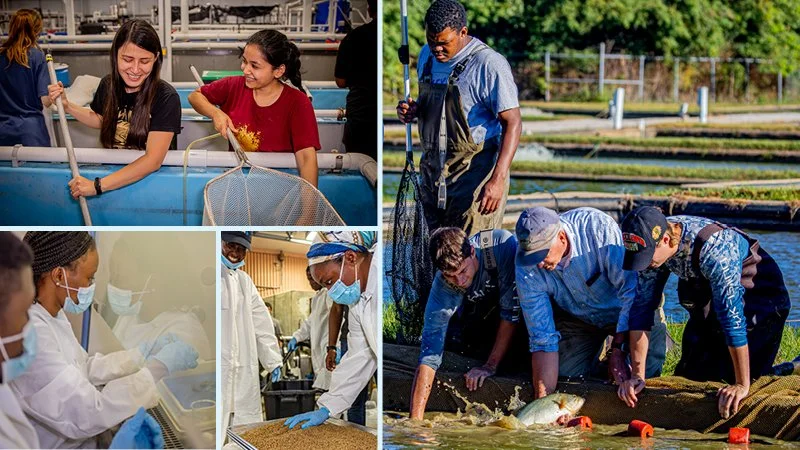
We also prepare students for a wide variety of roles beyond just fish farming. Because so much of what we do is water treatment, our graduates are well-equipped for high-tech jobs at municipal water plants or in natural resource agencies managing wild fish populations. Our master's program has a great reputation; about 44% of our students stay in Kentucky to work in the industry, while 32% go on to pursue a PhD. With a new Bachelor’s of Aquatic Science program launching soon and plans for a PhD program, we are focused on cultivating a talented workforce pipeline to drive aquaculture and aquatic science forward.
Why is Kentucky well positioned to support U.S. aquaculture’s growth despite being landlocked?
Kentucky fits perfectly into the agricultural landscape because soybeans and corn—the primary ingredients in fish feed diets—are top crops in our state. Since these inputs are grown locally, Kentucky serves as a natural, centralized hub for fish feed production. Additionally, our land costs are lower than elsewhere in the country, and our unique limestone geology provides high-quality water that is as great for aquaculture as it is for bourbon and horses.
Our centralized location sets KSU's program apart: two-thirds of the U.S. population is within a one-day drive of where I’m sitting right now. If you look at a map, major cities like New York, Chicago, and D.C. are all within a roughly 600-mile radius. This uniquely positions us to get fresh seafood to interior states—where 60% of the population lives—within a single day. We are also home to the country’s largest UPS hub, making us a perfect model for supplying the interior of the country.
What steps should the U.S. take now to strengthen its aquaculture industry for the future?
We really need to focus on narrowing our $20 billion seafood trade deficit. Right now, we import most of our seafood, and that’s a huge missed opportunity for domestic jobs and food security. To change that, we need to invest in workforce development and research institutions that are doing the heavy lifting to train the next generation.
A major hurdle the industry faces is public perception. There’s a lot of old, negative information about farm-raised seafood, and we need to do a better job of educating the public and our leaders about the health benefits and the high standards of modern aquaculture. It takes a real partnership between academia, the government, and the private sector to build a pipeline that connects students to careers and supports U.S. aquaculture growth to ensure we have a steady, sustainable supply of healthy protein.
How would the expansion of open ocean aquaculture in U.S. waters create new job opportunities for students preparing to enter the aquaculture field?
This is a budding industry, and like any industry, there are specialized jobs that must be developed and fine-tuned for it to succeed. New opportunities will include high-tech jobs using underwater and aerial drones, and A.I. that predicts the effects of wide-ranging environmental variables. We will need scientists who study topics such as water chemistry, animal health, genetics and breeding, and unique diet formulations specific to open ocean environments. Hatcheries will largely be situated inland and utilize RAS, which require highly skilled employees to operate them. The open ocean aquaculture industry will need innovators who develop new technologies, such as predator exclusion mechanisms and anti-fouling materials. Ultimately, we need students who dream big and focus on consistent improvement to adapt to the ocean environment.
KSU is taking these factors into consideration as we develop curriculum and content for our academic and research programs, and our graduates work throughout the wide-ranging aquaculture industry. Students leave KSU with the experiences they need, as well as the scientific rigor to confront and adjust to a changing food production landscape.
Read more from Dr. Andrew Ray and KSU’s Aquaculture Research Center: With almost 80% of seafood imported, can KSU turn the tide?
Learn more about KSU’s Division of Aquaculture: Division of Aquaculture