
Rep. Mike Ezell on Why Aquaculture Expansion Matters for U.S. Seafood
Industry leaders, congressional and administration staff, and Members of Congress gathered on Capitol Hill last week to discuss a key solution to the challenge of how the U.S. can keep up with rising seafood demand—while also supporting domestic producers and coastal communities.
The solution is the bipartisan Marine Aquaculture Research for America (MARA) Act of 2025. A May 13 legislative fly-in and seafood reception hosted by Stronger America Through Seafood (SATS) produced a rich discussion about open ocean aquaculture and the MARA Act’s science-based framework for commercial-scale open ocean aquaculture in U.S. federal waters.
Rep. Mike Ezell (R-MS), a House co-sponsor of the MARA Act, spoke to a roomful of reception attendees about why he sees open aquaculture as an essential part of the country’s seafood future.
“The demand for seafood is really going up, and it’s not just here at home but globally. People want access to good, healthy seafood and affordable protein,” Ezell said. “Offshore aquaculture, when it’s done right, can help take the pressure off some of our fisheries, stabilize supply, and open up some opportunities for growth.”
Ezell emphasized that aquaculture would work alongside traditional U.S. wild-caught fisheries, which are reaching their sustainable limits, noting that it is “not about replacing our commercial fishermen.”
For coastal communities like those in his home state of Mississippi, he framed it as an additional tool—something that would complement the work of commercial fishermen, shrimpers, and oystermen while helping strengthen the broader seafood economy.
Ezell also stressed that any expansion would need to be guided by a clear federal framework grounded in science, accountability, and predictability.
“It starts with science—making sure that NOAA (National Oceanic and Atmospheric Administration) is doing the research so that we can get decisions based on real data and not on assumptions,” Ezell said. “It improves the permitting process—not by cutting corners—but by making it more efficient and predictable.”
The MARA Act also includes provisions related to workforce development and environmental safeguards. “It puts guardrails in place. We’ve got to protect the environment, ensure public input, and maintain accountability,” Ezell said.
He pointed to coastal communities along the Mississippi Gulf Coast as places that could play a major role in the industry’s future.
“We’ve got the great Mississippi coastline, we’ve got a great workforce… and we’ve got the expertise down there to get this done,” Ezell said. “But we’ve got to come up with some innovative thinking—and I think this is part of it.”
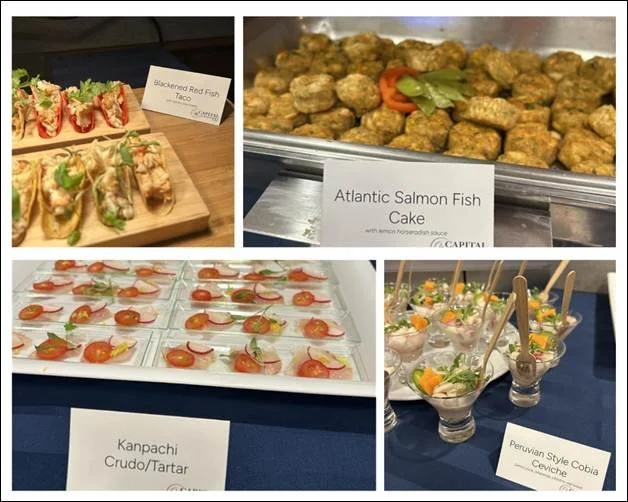
The reception also gave attendees a chance to taste an array of beautifully prepared farmed seafood, including fish cakes made with Atlantic salmon, blackened red fish tacos, crudo made with kanpachi (known as yellowtail), and a Peruvian-style ceviche made with cobia. The dishes were prepared with fresh seafood generously provided by SATS members Fortune Fish & Gourmet, Blue Ocean Mariculture, Open Blue, and Sysco. In attendance were SATS members Cargill, Innovasea, Sysco and Zeigler Bros., reflecting the range of companies involved in efforts to expand U.S. seafood production.
A broader theme throughout the event was global competition. As other countries continue investing in aquaculture, the United States risks falling further behind if it does not establish a clear path forward.
“The question is, are we going to lead this thing or are we going to sit on the sidelines? We’re going to lead,” Ezell said in his remarks.
As Congress considers the MARA Act, advocates agree that open ocean aquaculture expansion matters for economic and food security, but that growth will need to be guided by sound science and a policy framework that works for coastal communities and the environment.